Research
Research organized around clinically meaningful computation.
The goal is to extract structured, mechanistically relevant information from complex 4D Flow MRI data and carry it into more informative models of cardiovascular disease activity.
Research Thesis
Computational methods should make difficult flow data more interpretable, more reproducible, and more clinically useful, not less.
4D Flow MRI
Time-resolved flow structure
Clinical Focus
4D Flow MRI in aortic dissection
Aortic dissection remains clinically difficult because anatomy alone does not fully capture how blood continues to move through the dissected aorta over time.
In chronic dissection, the false lumen can remain perfused long after the initial event. That persistent flow matters because it may contribute to continued pressurization, remodeling, and later intervention risk.
This is one reason 4D Flow MRI is compelling in dissection: it provides time-resolved, volumetric flow information in vivo rather than only a static anatomic snapshot.
Clinical overview
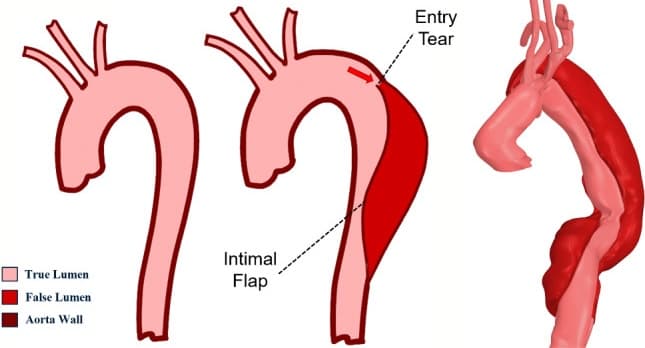
Adapted from Marimuthu et al., Biomechanics and Modeling in Mechanobiology, 2025.
Clinical problem
Continued false-lumen perfusion can sustain disease activity even when anatomy alone looks stable.
Why 4D Flow MRI matters
The modality makes patient-specific hemodynamics visible, but the resulting data are high-dimensional and difficult to summarize.
Computational direction
The goal is to derive structured, reproducible outputs from complex flow imaging that can be studied across cohorts and carried into future models.
Three-stage trajectory
Aim 1
Build interpretable computational tools
Develop reproducible computational methods that convert difficult cardiovascular MRI data into structured, clinically legible outputs.
Aim 2
Translate structured imaging readouts across cohorts
Apply computational pipelines across cardiovascular MRI cohorts, including aortic dissection, to study how standardized hemodynamic features relate to disease behavior beyond anatomy alone.
Aim 3
Move toward multi-agent patient modeling
Use validated imaging outputs as structured building blocks in future patient-level models that aggregate imaging, anatomic, and clinical information.